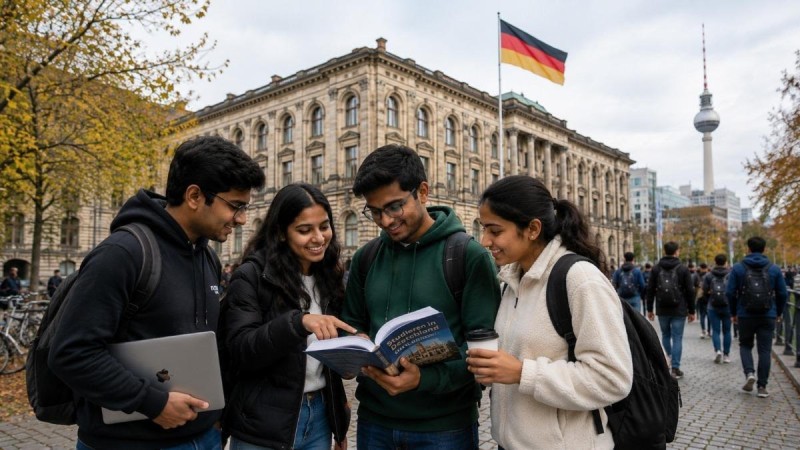
For years, the dream of studying abroad felt like it belonged to a specific kind of Indian student: someone from a metro city, an elite college, and a family with deep pockets. But that story is changing fast. Today, students from Sangrur, Patna, Surat, Nagpur, Hoshiarpur, Coimbatore, Kapurthala and hundreds of other smaller cities are packing their bags not for the US or UK, but for Germany.
And for good reason.
Studying in Germany has quietly emerged as the smartest, most accessible path for Indian students who have the ambition but not the unlimited budget. Here's why.
The Real Barrier Was Never Talent — It Was Cost
Let's be honest. The biggest reason Tier-2 and Tier-3 students hesitate about studying abroad isn't a lack of merit. It's the fear that they can't afford it or that their college background won't be "good enough."
A two-year master's degree in the USA can cost anywhere from ₹40–80 lakhs in tuition alone. The UK isn't far behind. Canada and Australia have grown expensive too. For a middle-class family in a smaller Indian city, these numbers feel unreachable.
Germany flips this equation entirely.
Near-Zero Tuition — This Is Real
Public universities in Germany charge virtually no tuition fees. Students pay only a semester contribution, typically between €150 and €350, which often covers a public transport pass and campus facilities. That's it.
Over a two-year master's programme, the total tuition cost is under ₹60,000–80,000. Compare that to what families pay for private engineering or MBA colleges in India itself, and Germany starts looking like an obvious choice.
This isn't a scholarship you have to compete for. It's the default. Every student at a German public university benefits from this system.
Your College Name Doesn't Decide Your Future Here
This is perhaps the most important point for students from Tier-2 and Tier-3 cities.
German universities don't care whether you studied at IIT Delhi or a state university in Bihar. What they evaluate is your academic performance, the relevance of your subject background, your statement of purpose, and your motivation. A strong GPA from a regional university can and regularly does get students admitted to top German programmes in Engineering, Computer Science, Data Science, and Business Management.
This is a meritocracy that doesn't punish you for where you grew up.
English-Taught Programmes Are Everywhere
One of the most common myths is that you need to speak German to study in Germany. While learning the language is certainly helpful, it is not a requirement to get started.
Hundreds of master's programmes are taught entirely in English, especially in STEM and management fields. If you're concerned about meeting language requirements, you'll want to read this detailed guide: Study in Germany Without IELTS — Scholarships & Admission Guide, which covers alternative pathways and scholarship options that make Germany even more accessible.
An IELTS score of 6.5 is sufficient for most programmes and an achievable target with focused preparation.
Work, Earn, and Fund Your Own Living Costs
International students in Germany are allowed to work up to 20 hours per week during the semester. At an average of €10–15 per hour, students can earn €800–1,200 a month, enough to cover a large portion of living expenses.
Monthly costs in most German cities range from €700 to €1,000, covering rent, food, transport, and personal expenses. Cities like Leipzig, Dresden, and Dortmund are notably more affordable than Munich or Frankfurt and are excellent choices for students on a tighter budget.
In short, a motivated student can effectively self-fund much of their time in Germany through part-time work alone.
The Germany Study Visa: More Straightforward Than You Think
Many students from smaller cities worry about the Germany study visa process, assuming it's complicated or unpredictable. In reality, Germany has one of the more transparent and student-friendly visa systems among major study destinations.
The key requirements include an admission letter from a recognised university, a blocked account with approximately €11,208 (proof of financial support for one year), health insurance, and academic documents. Approvals are consistent when documents are in order.
Working with a qualified Germany study visa consultant can make the process significantly smoother, especially if you're navigating it for the first time from a city without a German consulate. A good study visa consultant will help you prepare your blocked account, organise your documentation, and ensure your application is submitted correctly — reducing delays and stress considerably.
After Graduation: Real Careers in Europe
Getting the degree is one thing. What happens next matters even more.
Germany offers an 18-month post-study work visa, one of the most generous in Europe, specifically for international graduates to find employment in their field. This is not a rushed process. Students have a year and a half to interview, negotiate, and secure a role.
Starting salaries for engineers, software developers, and data professionals in Germany typically range from €45,000 to €65,000 per year. After two or three years of work experience, graduates can apply for permanent residency through the EU Blue Card pathway.
For a student from a Tier-2 Indian city, this represents a life-changing trajectory — not just a degree.
What About Scholarships?
Germany also offers meaningful scholarships for international students. The DAAD (German Academic Exchange Service) is the most prominent, offering merit and need-based funding. The Deutschlandstipendium is another programme that connects high-performing students with corporate and private sponsors.
Want a complete picture of how to study for free or at minimal cost? This resource lays it all out clearly: How to Study in Germany for Free — covering tuition-free universities, scholarship applications, and financial planning for Indian students.
The Bottom Line
Germany is not a backup plan. For students from Tier-2 and Tier-3 cities in India, it may actually be the best plan offering world-class education, zero tuition, a fair admissions process, strong career outcomes, and a clear immigration pathway.
You don't need to be from a metro. You don't need an IIT degree. You need a good academic record, a clear goal, and the right guidance to take that first step.
If a Germany student visa and a seat in a European university feel distant right now, know this: thousands of students from smaller Indian cities have made this journey in the last five years. The path is clear. You just need to start walking it.
Planning to study in Germany? Connect with a certified Germany study visa consultant to understand your eligibility, choose the right programme, and navigate the visa process with confidence.
Author: Raj Sharma is the Managing Director and a certified visa consultant at Abroad Gateway, bringing over 15 years of industry experience. He specialises in study, tourist, spouse, and PR visa consultations. Since 2010, he has successfully guided hundreds of clients towards achieving their international education and travel goals through personalised advice and in-depth expertise.